What tapestry crochet is
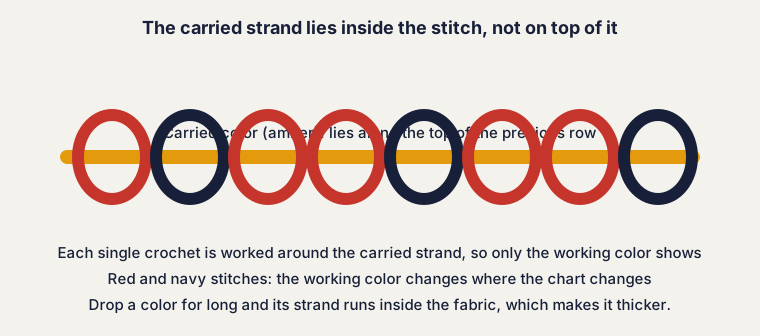
Tapestry crochet is single crochet worked over the strand of the colors you are not using. Each stitch is made around the carried yarn, so the carried color is buried in the fabric and only the working color shows. The result is a dense, firm fabric with a clean picture on both sides, and it is well suited to bags, baskets, pillows and wall hangings.
Because the fabric is made of single crochet stitches, each stitch is one cell of a chart. A tapestry crochet chart is a grid with one color in every cell, and you read it row by row, much like colorwork knitting.
Single crochet cells are not exactly square
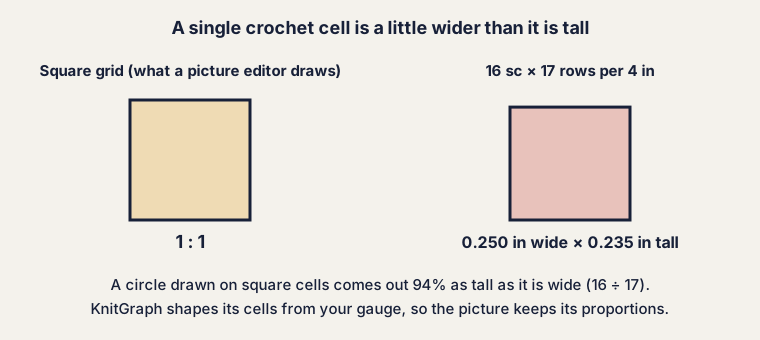
Many online charts use square cells. Single crochet stitches are close to square but usually a little wider than they are tall, so a picture drawn on a square grid comes out slightly squashed. The tool fixes this by asking for your gauge in single crochet and rows per 4 in, and drawing cells in the same shape as your stitches.
The difference is small, which is why you can often get away with a square grid. It adds up over a large piece, and it is obvious in a face or a circle. Your own gauge may be different from 16 × 17. Always enter numbers from your own swatch, made in the yarn and hook you plan to use, with a second color carried through it.
Tapestry crochet pattern generator: using the maker
This tapestry crochet chart maker takes a picture, a word or a blank page. Choose a sample to see how it behaves, or drop in your own picture. Strong shapes with few tones work best, since each cell has to become a flat color. Then work down the three steps: set the width in stitches, enter or choose your gauge, and pick the number of colors and how much to tidy stray single stitches.
The Fabric preview tab shows an approximation of the crocheted result. Use Draw, Fill and Pick to fix details, with Undo and Redo to step back. You can download the chart as a PNG, print it or save it as a PDF tiled across pages with a color key, copy the written rows, or copy a share link that reopens the chart. Knit mode, which also works for crochet, highlights one row at a time and lets you step through them with Back and Next.
Flat or in the round
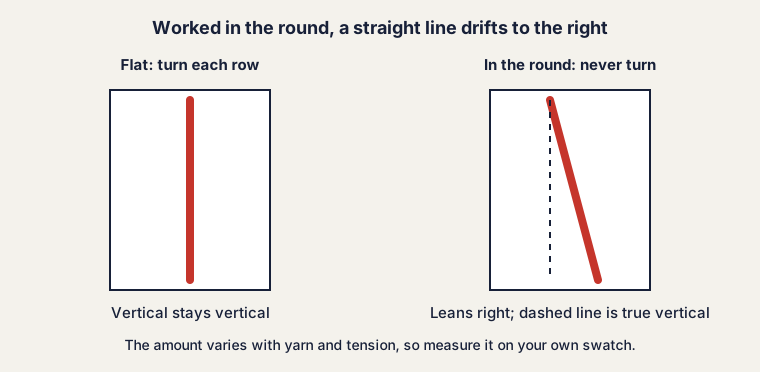
You choose how the piece is worked, and the written rows change to match. Worked flat, you turn at the end of every row. Right-side rows are read from right to left and wrong-side rows from left to right. Worked in the round, you never turn, and every round is read from right to left.
Flat work suits wall hangings and flat bag panels. The round suits bags, baskets and pouches that are made as tubes. For a tube, the number of stitches in a round is the distance around. A round of 64 stitches at 16 per 4 in is 64 × 0.25 = 16 in around, which is about 5.1 in across.
The rightward lean in the round
Single crochet worked in the round and always in the same direction leans. A vertical line in your chart drifts to the right as the rounds go up. How much depends on your yarn, your hook and your tension, so judge it on your swatch rather than from a number in a table. The chart tool does not correct for it.
There are three common ways to reduce it:
- Work into the back loop only, which changes where each stitch sits.
- Use a center single crochet, sometimes called a waistcoat stitch, which puts the hook through the middle of the V below.
- Shift the chart by hand. Moving the drawn picture a stitch at a time in the opposite direction, with Draw and Fill, evens out the drift on a tall piece.
Try each on a small swatch worked in the round. Hold a ruler against a vertical line of a single color and see how far it moves after 20 rounds.
How many colors to carry at once
The tool lets you pick 2 to 12 colors, but few of those are used at the same time. In a given row you will usually carry one or two background colors under the stitches while a third is working. Each carried strand makes the fabric thicker and stiffer, and every color you add is another yarn to keep untangled. Start with 2 or 3 colors and add more only when the picture needs them.
Keeping carried yarn from showing
Carried yarn shows when it is pulled tight, or when it travels a long way between uses. To avoid this, keep it level with the top of the previous row, work the stitch around it without tugging, and change colors on the last pull of the stitch before the new color. If a color is not needed for more than 10 to 15 stitches, cut it and start fresh instead of carrying it. These are habits, not rules from the tool, so test them on your swatch.
Reading the written rows
The Written rows tab lists each row as single crochet counts per color. An entry such as 12 A means 12 single crochet in color A. Read a row from the right when you are on a right-side row or when working in the round, and from the left on a wrong-side row. Check the first few rows against the chart before you trust the rest.
Pick a width for bags, pillows and wall hangings
Work out the width from the size you want: stitches = inches × 16 ÷ 4 at 16 per 4 in, and rows = inches × 17 ÷ 4 at 17 per 4 in. Here are three examples at 16 × 17:
| Project | Size (in, W × H) | Stitches | Rows |
|---|---|---|---|
| Bag panel | 12 × 12 | 48 | 51 |
| Pillow | 16 × 16 | 64 | 68 |
| Wall hanging | 20 × 30 | 80 | 128 (127.5 rounded up) |
The wall hanging at 128 rows is 128 × 4 ÷ 17 = 30.1 in tall. For a stitch count that includes a border, add the border stitches to the chart width.
What this tool does not do
The tool works out sizes from your gauge. It does not predict how your yarn will behave, how tight your carried strands will be, or how much yarn a piece will take, so swatch first and weigh the swatch to plan quantities. It also does not correct for lean. Treat the preview as a guide to the picture, not a photograph of the finished piece. For a related technique worked in diagonal blocks, see the C2C crochet pattern generator, or go back to the knitting chart maker.
Questions crocheters ask
How do I make a tapestry crochet chart from a picture?
Drop the picture into the tool above, set the width in stitches and your gauge, choose the number of colors, then tidy the chart with Draw, Fill and Pick. The Written rows tab lists each row as single crochet counts per color.
How many colors can I use in tapestry crochet?
The tool allows 2 to 12 colors. In practice most tapestry crochet works best with 2 or 3 colors in a row, because every color you carry adds a strand inside the stitches.
Why does my tapestry crochet lean when I work in the round?
Single crochet worked in the round without turning slants in one direction, so vertical lines drift to the right. Working in the back loop only, or using a center single crochet, reduces it.
What gauge should I enter?
Work a swatch in the same yarn and hook, carrying a second color, then count single crochet and rows across 4 inches. The presets, such as 16 × 17, are starting points.
What is the difference between flat and in the round in the written rows?
Worked flat, right-side rows read right to left and wrong-side rows left to right. Worked in the round, every round is read right to left.
Is my picture uploaded anywhere?
No. The picture is processed in your browser and never leaves your device. There is no account to make.