Why knitting graph paper has wider-than-tall cells
A knit stitch in stockinette is wider than it is tall. At a common light worsted gauge of 20 stitches and 28 rows over 4 in, one stitch is 0.200 in wide and 0.143 in tall. That is a ratio of 1.4 to 1. Ordinary graph paper has square cells, so it cannot show you what a design will look like in knitting. Knitting graph paper fixes this by making each cell the shape of one stitch.
What goes wrong on square graph paper
Suppose you draw a circle 20 cells wide and 20 cells tall on square paper. You knit it at 20 stitches and 28 rows per 4 in. The circle is 20 stitches wide, which is 4 in. It is 20 rows tall, which is 20 × 0.143 = 2.86 in. The height is 2.86 / 4 = 71% of the width, so your circle becomes a flat oval.
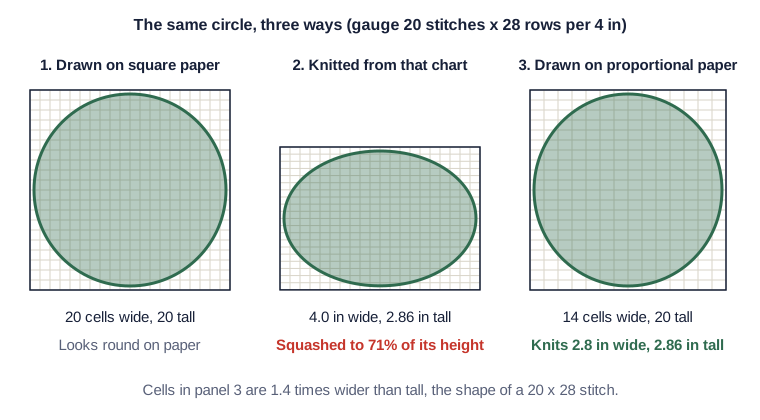
The fix is to draw on cells that are 1.4 times wider than tall. Draw the same circle there and it looks round on the page. On the grid it takes 14 stitches across and 20 rows up, and it knits up 2.8 in wide and 2.86 in tall. This is what proportional knitting graph paper is for.
How to measure gauge for your graph paper
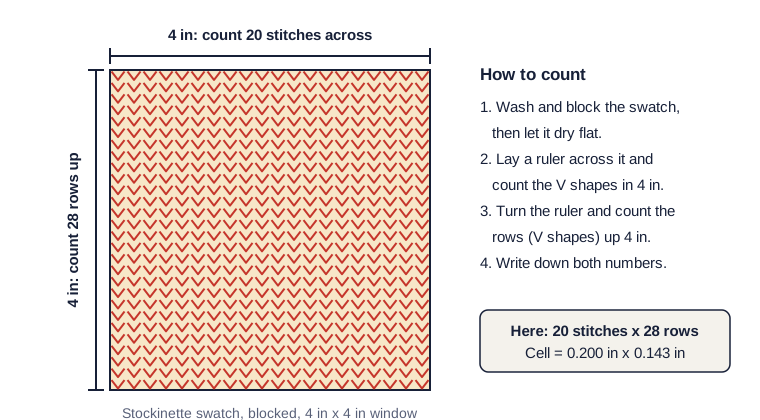
The presets are typical values, and your hands are your own. For paper you can trust, measure a swatch in the stitch pattern and yarn you will use.
- Knit a swatch at least 6 in square, so the edges do not distort the middle.
- Wash and block it the way you will treat the finished piece, then let it dry flat.
- Lay a ruler across the middle and count the stitches in 4 in.
- Turn the ruler and count the rows in 4 in.
- Type both numbers into the generator.
Quarter stitches are accepted. Row gauge in stockinette is usually about 1.3 to 1.4 times the stitch gauge, but yarn, needles and tension can move it.
Common gauges and the cell each one needs
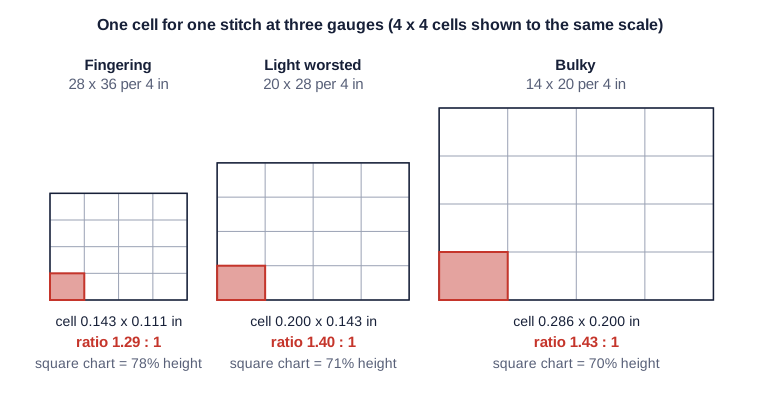
Stitch width is 4 divided by stitch gauge. Row height is 4 divided by row gauge. The ratio is stitch width divided by row height, which equals row gauge divided by stitch gauge. The last column shows how tall a design drawn on square cells will knit, as a share of its drawn height.
| Yarn weight | Gauge per 4 in | Stitch width | Row height | Cell ratio | Square chart knits at |
|---|---|---|---|---|---|
| Fingering | 28 × 36 | 0.143 in | 0.111 in | 1.29 : 1 | 78% |
| Sport | 24 × 32 | 0.167 in | 0.125 in | 1.33 : 1 | 75% |
| DK | 22 × 30 | 0.182 in | 0.133 in | 1.36 : 1 | 73% |
| Light worsted | 20 × 28 | 0.200 in | 0.143 in | 1.40 : 1 | 71% |
| Worsted | 18 × 24 | 0.222 in | 0.167 in | 1.33 : 1 | 75% |
| Aran | 16 × 22 | 0.250 in | 0.182 in | 1.38 : 1 | 73% |
| Bulky | 14 × 20 | 0.286 in | 0.200 in | 1.43 : 1 | 70% |
Printable knitting graph paper: actual size or fit to a width
The generator has two ways to size the cells.
Actual stitch size makes each cell exactly one stitch at your gauge. A 20 × 28 gauge on US Letter with 0.5 in margins gives cells 0.200 in wide and 0.143 in tall. That fits 37 cells across and 70 down.
Fit a number of stitches scales the cells so that a stitch count you choose fills the printable width, and keeps the same stitch shape. Fit 40 stitches on the same Letter page and each cell becomes 0.1875 in wide and 0.134 in tall, which gives 74 rows. Cells keep your stitch shape in both modes, but in fit mode they are no longer life size.
Printing knitting graph paper at true scale
The page you see above is drawn in inches, and the file is sized in inches or millimeters, so the printer has what it needs. The one thing that can go wrong is the print dialog. Choose 100% or Actual size, and turn off Fit to page or Shrink to fit.
Check the result with a ruler before you draw anything. Measure 20 cells across. At 20 stitches per 4 in, 20 cells should measure 4 in (10.2 cm). More generally, 20 cells should measure 20 × 4 / stitch gauge inches. Measure 28 cells up as well. At 28 rows per 4 in, that is also 4 in. If both are off by the same amount, the dialog scaled the page, so print again at 100%.
Using proportional knitting graph paper for colorwork, intarsia and lettering
Shade each cell with a pencil or marker in the color of that stitch. Read the chart from the bottom up. Right-side rows read right to left, wrong-side rows left to right, and rounds always read right to left.
Stranded colorwork. Stranded, or Fair Isle, work carries the unused color across the back as a float. Common advice is to catch floats longer than about 5 stitches, or about 1 in. On your paper, look at each row and mark any run of one color that is longer than 5 cells.
Intarsia. Intarsia uses a separate length of yarn for each block of color and has no floats, so you can draw large shapes without worrying about run length. A square chart will make hearts and diamonds look short.
Lettering. Letters are the easiest way to see the problem. A block capital drawn 7 cells wide and 9 cells tall on square paper looks tall and narrow when knitted, because rows are shorter than stitches. On proportional paper the letters on the page look slightly wide, and they knit up with the shape you drew. Plan the full width before you start so you can center the word.
When square graph paper is fine
Some crafts work on a grid that is already close to square. Cross stitch is counted on an even-weave grid, and the stitches are square. Corner-to-corner crochet is worked in blocks, usually a chain 3 and 3 double crochet, and each graph square is one block. Single crochet is close to square too, but usually a little wider than it is tall. A gauge of 16 stitches and 17 rows per 4 in gives a ratio of about 1.06 to 1, so check your swatch before you decide.
Draw by hand or convert a picture
Hand drawing is the right choice when you design as you go or like to work away from a screen. If you would rather start from a photograph, a logo or a word, the knitting chart maker turns a picture into a chart on the same stitch-shaped cells, checks for long floats and writes the rows out for you.
Questions knitters ask
What size is knitting graph paper?
There is no single size. Each cell should be one stitch wide and one row tall at your own gauge. At 20 stitches and 28 rows per 4 in, a cell is 0.200 in wide and 0.143 in tall. This generator works that out from your gauge.
Why not just use normal graph paper?
Normal graph paper has square cells, but a knit stitch is wider than it is tall. A design drawn on square cells knits up shorter than you drew it. At 20 x 28 the finished piece is about 71% of the drawn height.
How do I get the gauge numbers?
Knit a swatch in the stitch pattern you plan to use, wash and block it, then count the stitches across 4 in and the rows up 4 in. Use those two numbers, not the ones on the yarn label, when you want a precise result.
Can I use this paper for stranded colorwork, intarsia and lettering?
Yes. Shade each cell with the color of that stitch. For stranded work, mark any run of one color longer than about 5 stitches so you remember to catch the float. For lettering, draw the letters on the proportional grid and they will keep their shape.
Will it print at the right size?
Yes, if you print at 100% scale. In the print dialog, choose Actual size or 100%, and turn off Fit to page. Then measure 20 cells with a ruler to confirm. At 20 stitches per 4 in, 20 cells measure 4 in.
Is square graph paper ever fine?
Yes. Cross stitch and corner-to-corner crochet blocks are close to square, so square paper works for them. Single crochet is close to square too, but a slight difference is common, so check your swatch.
Can I turn a photo into a chart instead?
Yes. The knitting chart maker converts a picture or a word into a chart on cells shaped to your gauge, so you do not have to draw it by hand.