Increase evenly across a row: the arithmetic
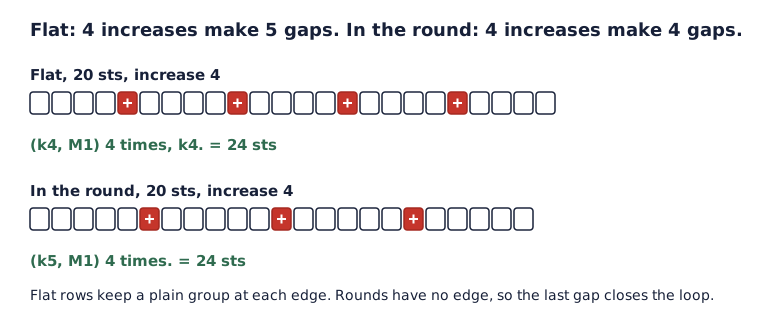
To add N stitches across a row of S stitches, you need N places to put them and a plain stretch of knitting between each. Worked flat, the row splits into N + 1 gaps: a stretch at the start, one between each pair of increases, and a stretch at the end. Worked in the round, the row has no ends, so N increases make N gaps.
Take 20 stitches and 4 increases worked flat. That is 5 gaps, and 20 / 5 = 4 plain stitches in each. The instruction is (k4, M1) 4 times, k4, and the row finishes with 24 stitches. This is the sum the knitting increase calculator above does for you. The same 20 stitches in the round, with 4 increases, is 4 gaps of 5: (k5, M1) 4 times, finishing with 24 stitches.
Which increase and which decrease
The calculator writes M1 for every increase and k2tog for every decrease. Use whatever your pattern prefers. M1L and M1R lift the strand between two stitches and twist it, which leaves almost no mark and is the usual choice for even shaping. Knit front and back (kfb) is faster and leaves a small bar on the right side. A yarn over leaves a hole, so keep it for lace.
For decreases, k2tog leans to the right and ssk leans to the left. On a flat row or a crown, alternate them so the shaping looks balanced. On a single even decrease row you can use k2tog throughout and nobody will notice, but a visible line of decreases looks neater when the lean matches the direction of the seam.
Decrease evenly calculator: the two-stitch rule
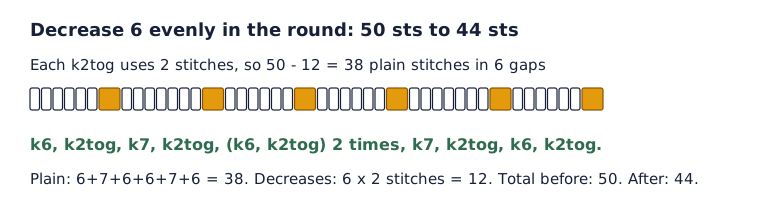
A decrease uses two stitches to make one, so every decrease takes two stitches out of the plain count. With S stitches and N decreases, the plain stitches are S − 2N, and those fill N + 1 gaps flat or N gaps in the round. Take 50 stitches in the round, decreasing 6. Twelve stitches go into the decreases, leaving 38 plain. Dividing 38 by 6 gaps gives 6 with 2 left over, so four groups of 6 and two groups of 7: (k6, k2tog) 2 times, (k7, k2tog) 2 times, (k6, k2tog) 2 times, finishing with 44 stitches. The knitting decrease calculator above applies the same two-stitch rule.
How to increase stitches evenly when the numbers do not divide
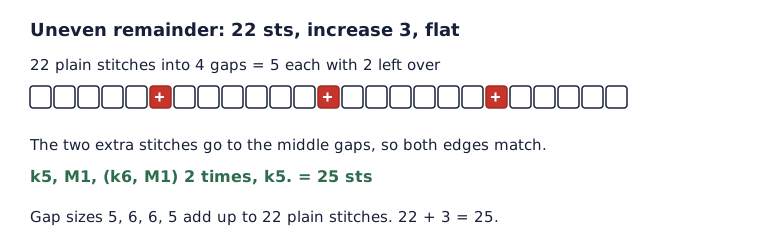
Most real counts do not divide cleanly. Take 22 stitches and 3 increases flat. That is 4 gaps, 22 / 4 = 5 with 2 left over. Two of the four groups get an extra stitch, and putting them in the middle keeps the edges plain and equal: 5, 6, 6, 5. The line reads k5, M1, (k6, M1) 2 times, k5, and the row ends at 25 stitches.
Some counts leave an odd remainder that cannot be split symmetrically. On 41 stitches with 6 flat increases, the groups come out 6, 6, 6, 6, 6, 6 and 5, so the last group is one stitch shorter. A one-stitch difference between groups is invisible in the fabric. If you want it perfectly symmetric, change the stitch count or the number of increases by one.
Why edges matter on flat pieces
On a flat piece the first and last stitches go into a seam or take a border. An increase or decrease right at the edge makes a bulge or a gap that is hard to sew. Keeping a plain stretch at both ends is why a flat row has N + 1 gaps. If the calculator reports a decrease at the very edge, it means the request left no plain stitches at an end, and you should consider fewer decreases.
Shaping examples: hats, sleeves, yokes and ribbing
Ribbing to body. A hem with 96 stitches that must become 110 for the body needs 14 increases in the round. The calculator gives k6, M1, (k7, M1) 12 times, k6, M1. The gaps run 6, 7 (twelve times), 6, which sum to 96, and 96 + 14 = 110.
Hat crown. A hat with 88 stitches and 8 decreases in the round has 88 − 16 = 72 plain stitches in 8 gaps of 9: (k9, k2tog) 8 times, leaving 80. Repeat the shaping on following rounds with fewer plain stitches in each gap until the top closes.
Round yoke. A yoke of 120 stitches that grows to 144 needs 24 increases in the round: 120 / 24 = 5, so (k5, M1) 24 times. Do this on a plain round between pattern rows.
Sleeve. A sleeve 18 in long at 7.5 rows per inch is 135 rows. Twelve increase rows over 135 rows is 135 / 12 = 11.25 rows apart, so work nine increase rows 11 rows apart and three 12 rows apart: 9 × 11 + 3 × 12 = 135. The row spacing follows the same arithmetic as the stitch spacing. To find a row gauge from a swatch first, use the knitting gauge calculator.
Using this knitting increase calculator and knitting decrease calculator
Use the knitting increase calculator and the knitting decrease calculator in the same way. Choose Increase or Decrease, choose flat or in the round, then enter the stitches you have and how many to add or remove. The written line appears in the box, with a Copy button, together with the new stitch count and a drawing of the row. White squares are plain stitches, red squares with a plus are new stitches, and a joined amber pair is a k2tog. The drawing stops at 120 stitches and says so, because longer rows would be too small to read; the written line always covers the whole row.
If you are charting a colorwork design instead, the knitting chart maker draws the grid shaped to your gauge.
Limits
This is arithmetic on stitch counts. It does not know your pattern stitch, so check that increases fall on a plain knit stitch and not inside a cable or a lace repeat. It spaces increases evenly in a single row; if the change is large it is usually better to spread it over several rows. Both the knitting increase calculator and the knitting decrease calculator refuse requests that cannot be worked in one row: decreasing more than half the stitches, or increasing by more than one stitch per gap. Neither is a substitute for reading your pattern.
Questions knitters ask
How do I increase 12 stitches evenly across a row?
Split the row into 13 gaps if you work flat, or 12 gaps if you work in the round, then put one increase in each gap. On 60 stitches in the round, 60 / 12 = 5, so you work (k5, M1) 12 times and finish with 72 stitches. Enter your own numbers in the calculator and it writes the line for you.
Why does a flat row have one more gap than increases?
Increases go between stitches and you do not want one at the very edge of the work. Four increases across a flat row create five stretches of plain knitting, one at each end and three between. In the round there is no edge, so four increases make four stretches.
How many stitches can I decrease in one row?
At most half of them. A k2tog or ssk uses two stitches to make one, so 50 stitches allows up to 25 decreases, which leaves 25. In practice you rarely want to go that far, because the fabric bunches. The calculator shows a message when the request is impossible.
Which increase should I use, M1 or kfb?
Use M1L or M1R when you want the increase to be nearly invisible, and kfb (knit front and back) when you want a quick, slightly visible bar. A yarn over leaves a hole, which is right for lace and wrong for a plain yoke. The written line says M1; swap in the increase your pattern asks for.
What if the stitches do not divide evenly?
Some groups get one more plain stitch than others. The calculator puts the longer groups toward the middle and tells you when it has done so. The difference of one stitch between groups is not visible in the fabric.
Should the decreases lean left and right?
For a flat piece or a crown, pair k2tog (leans right) with ssk (leans left) so the shaping looks balanced. The calculator writes k2tog for every decrease. Swap every other one for ssk, or follow the pattern's instruction for which side leans which way.