Gauge calculator knitting starts with a good swatch
Every number above comes from your swatch, so the swatch matters more than the arithmetic. Cast on at least 6 in (15 cm) of stitches in the yarn and needles you plan to use, in the pattern stitch the project uses. Work about 6 in of fabric, then bind off or leave the stitches on the needle without stretching them.
Wash and dry the swatch the way you will treat the finished piece, then lay it flat or pin it to the blocking shape without pulling. Measure in the middle, at least an inch away from the edges, where the edge stitches pull the fabric out of shape. Lay a ruler across, count whole stitches against it, and write down the width. Do the same up a column for rows. Counting over a larger span, such as 4 in, gives a steadier answer than counting over 1 in.
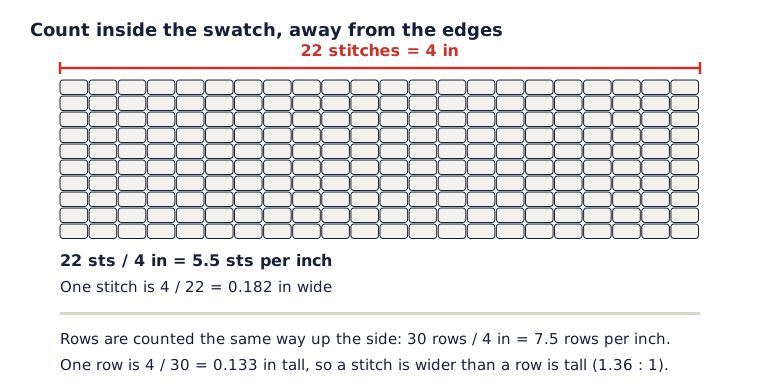
Stitches per inch and rows per inch
Divide the count by the span you counted over. Stitches per inch is the stitches divided by the width. Rows per inch is the rows divided by the height. Patterns usually print gauge over 4 in (10 cm), so the calculator also multiplies by 4.
Stitch gauge and row gauge are different numbers. A knit stitch in stockinette is wider than a row is tall. At 22 stitches and 30 rows over 4 in, one stitch is 4 / 22 = 0.182 in wide and one row is 4 / 30 = 0.133 in tall. Row gauge usually runs about 1.3 to 1.4 times the stitch gauge, and here 30 / 22 is 1.36. That is also why a chart drawn on square graph paper looks squashed when knitted, which our knitting chart maker corrects by drawing cells in your stitch shape.
Cast on calculator: how many stitches for a width
The rule is simple: stitches to cast on equal the width in inches times stitches per inch. For a 20 in piece at 5.5 stitches per inch that is 20 × 5.5 = 110 stitches. Rows work the same way. A 24 in length at 7.5 rows per inch is 24 × 7.5 = 180 rows.
Patterns often need a stitch count that fits a repeat, such as a multiple of 8 plus 2 edge stitches. Enter the repeat in step 2 and the cast on calculator rounds to the nearest valid count. At 5.5 stitches per inch, 20 in needs 110 stitches. The nearest counts that are a multiple of 8 plus 2 are 106 and 114, and the tool picks 114 because 110 sits exactly halfway and it rounds up. Those 114 stitches give 114 / 5.5 = 20.73 in. The calculator states this rounding and shows the real width, so you can decide whether to go down to 106 (19.27 in) instead.
Why half a stitch per inch matters
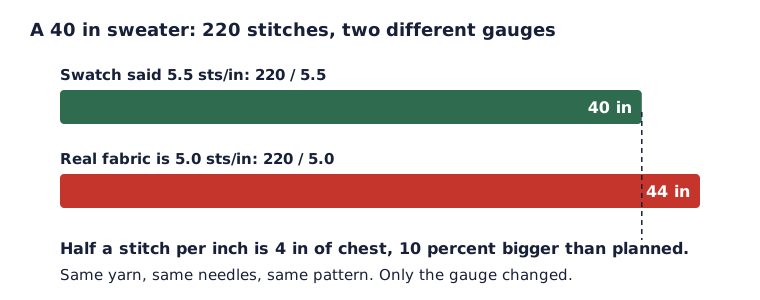
A small error in gauge looks harmless on a swatch and large on a sweater. Say a 40 in chest needs 220 stitches, which assumes 5.5 stitches per inch. If your fabric is really 5.0 stitches per inch, those 220 stitches measure 220 / 5.0 = 44 in. A difference of half a stitch per inch makes the sweater 4 in too big, or 10 percent, with the same yarn, the same needles and a pattern followed exactly.
Knitting gauge adjustment calculator: match a pattern
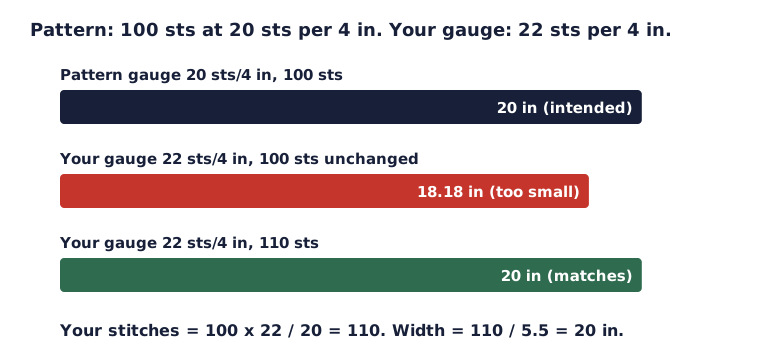
Step 3 handles a pattern written for a different gauge. Your stitch count equals the pattern stitch count times your gauge divided by the pattern gauge. If the pattern gives 20 stitches per 4 in and calls for 100 stitches, and your swatch is 22 stitches per 4 in, you need 100 × 22 / 20 = 110 stitches for the same 20 in width.
Following the pattern numbers unchanged would give 100 / 5.5 = 18.18 in instead of 20 in, which is 9.1 percent narrower. The tool shows both sizes so you can see the cost of skipping the math. Rows convert the same way, using the row gauges. After converting, adjust to the nearest pattern repeat and check that shaping still lands on whole stitches.
Needle size, yarn weight and typical gauges
If your gauge is off, change needle size before changing the pattern. Larger needles loosen the fabric and give fewer stitches per inch, smaller needles tighten it. A change of one size can move the gauge by a fraction of a stitch, so make the change, then knit and measure a new swatch. Needle size is the quickest way to bring a gauge back to the printed number.
Yarn weight sets the range you can expect. These are stockinette ranges over 4 in from the Craft Yarn Council, with the per inch values worked out from them.
| Yarn weight | Stitches per 4 in | Stitches per inch |
|---|---|---|
| Fingering | 27 to 32 | 6.75 to 8 |
| Sport | 23 to 26 | 5.75 to 6.5 |
| DK | 21 to 24 | 5.25 to 6 |
| Worsted | 16 to 20 | 4 to 5 |
| Bulky | 12 to 15 | 3 to 3.75 |
| Super bulky | 7 to 11 | 1.75 to 2.75 |
Treat these as a sanity check. A swatch that lands far outside the range for its yarn weight usually means the needles are the wrong size or the count is off.
Metric gauge
Many patterns give gauge over 10 cm. Switch the unit to centimeters in step 1 and the calculator converts for you. For example, 22 stitches over 10 cm is 2.2 stitches per cm, or 5.59 stitches per inch, which is 22.35 stitches per 4 in. The two standard spans are not identical, since 4 in is 10.16 cm, so convert before comparing a pattern in one unit to a swatch in the other.
Limits of a gauge calculator
The results are estimates from the numbers you type. Fabric changes with the project: gauge in the round can differ from flat, a lace or cable swatch differs from stockinette, and many fibers relax after washing. Swatch in the pattern stitch, measure after washing, and check your gauge again after a few inches of the real piece. If you are shaping, the knitting increase and decrease calculator spreads the added or removed stitches evenly across a row.
Questions knitters ask
How do I calculate knitting gauge?
Count the stitches across a measured width in the middle of your swatch, then divide by that width. Twenty-two stitches over 4 inches is 22 / 4 = 5.5 stitches per inch. Do the same with rows counted over a measured height. The calculator above does both, and also gives the per 4 in and per 10 cm figures patterns use.
How many stitches do I cast on for a given width?
Multiply the width in inches by your stitches per inch. For 20 inches at 5.5 stitches per inch that is 110 stitches. If the pattern stitch needs a repeat, round to the nearest count that fits it. The cast on calculator in step 2 does this rounding and shows the width those rounded numbers actually give.
What if my gauge does not match the pattern?
Change the needle size first and swatch again, because a pattern is designed around its gauge. If you cannot match both stitches and rows, match the stitches, then recalculate the stitch and row counts with step 3. Shaping and length will need small adjustments.
Should I measure gauge before or after washing?
After. Wash and dry the swatch the way you will care for the finished piece, then pin or lay it flat and measure. Many yarns grow, shrink or relax once they are wet, so a dry swatch straight off the needles can mislead you.
Which is more important, stitch gauge or row gauge?
Stitch gauge decides the width, which controls fit, so match it first. Row gauge decides length, and you can usually fix length by working to a measurement instead of a row count. Patterns that count rows for sleeve caps or yoke depth need both.
Can I use centimeters?
Yes. Switch the unit to cm in step 1 and enter the width you measured. The calculator converts everything and still shows the per 4 in and per 10 cm numbers. Remember that 4 in is 10.16 cm, so mixing the two spans without converting gives a small error.
Is the result exact?
It is a calculation from the numbers you enter, so it is only as good as your swatch. Knit a swatch at least 6 in (15 cm) wide, measure in the middle, and expect to adjust after the first few inches of the real piece.